Research
Research
Good Practice
CGE has maintained a research focus as part of its work for over three decades to enhance good practice in global education and strengthen the policy environment in which it is delivered. In fulfilling this aim the CGE carries out research in three specific areas.
- We monitor and evaluate our global education activities both internally and externally to assessthe impact of our work on learners. This form of research is carried out internally by the Centre’s staff and externally by independent consultants.
- We commission research on global education practice to illuminate the links between the island of Ireland and the global South and to influence debate on the practice of global education by documenting and disseminating learning we acquire through our work.
- We commission research on global education to advance policy and practice in areas of social justice, sustainability and equality.
Exploring the Elephant in the Room: Attention to Economic Neo-liberalism in Development Education and International Development on the Island of Ireland (2025)
This research, commissioned by the Centre for Global Education and Financial Justice Ireland, and compiled by independent consultant Harm-Jan Fricke, investigates the attention given by global education practitioners to the dominant global economic system (neoliberalism) as the root cause of poverty, inequality, and injustice. The research identifies the challenges and opportunities for interpreting the structural reality of neoliberalism in global education and highlights methodologies to support a systemic approach to addressing root causes.
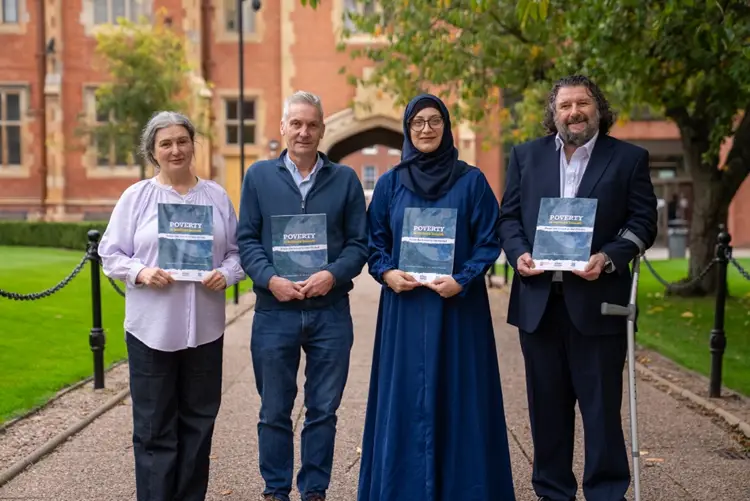
Poverty in Northern Ireland: From the Local to the Global (2025)
In 2025, CGE commissioned Queen’s University’s School of Social Sciences, Education and Social Work to carry a systematic literature review from 2020-2024 titled Poverty in Northern Ireland: From the Local to the Global. The research was a comparative study of Northern Ireland poverty in a UK, all-Ireland and international context by drawing upon international comparators from Europe and the rest of the world. The report makes informed recommendations that could support effective anti-poverty policy interventions in Northern Ireland.
DSAI Working Paper: The Impact of Lebanon's Economic Crisis on Palestinian Refugees (2023)
This report assesses the impact of Lebanon’s current economic crisis on the socio-economic status of 180,000 Palestinian refugees living in the country. Since 2019, Lebanon’s economy has been locked in a prolonged crisis triggered by a debt default that has seen the currency lose 98 per cent of its value and inflation rocket to 200 per cent. This has caused a surge in the prices of daily necessities such as food, domestic fuel and transportation. Palestinians have been on the frontline of this economic crisis. Displaced from their homeland since 1948, Palestinian refugees in Lebanon have never been naturalized, are excluded from 39 syndicated occupations and denied property rights. Their marginal status has been exacerbated by the arrival of 29,000 Palestinian Refugees from Syria (PRS) who have fled the civil war in Syria. This has created a race to the bottom in terms of competition for low paying jobs in the informal sector. Palestinians have also been severely impacted by the COVID-19 pandemic, and their health, education and living conditions are deteriorating as a consequence of Lebanon’s economic meltdown. The report is based on three field visits to nine Palestinian camps in Lebanon in 2022 and the latest research by UN agencies working in the country
International Development and Development Education: Challenging the Dominant Economic Paradigm?
In 2022, CGE compiled a research study in partnership with Financial Justice Ireland, which explored the extent to which the international development and global education sectors on the island of Ireland are engaging with the neoliberal economic system as the root cause of poverty, inequality and injustice. The research that “neither the international development nor the development education sector give anywhere near adequate attention to explorations with the public of the economic causes of poverty, inequality and injustice and of responses, through education, to the global neoliberal system”.